Graves on the Trail
It is common to pass burial sites on hill trails in China. These are not abandoned graves or anything ominous, they are maintained family burial plots, often with stone surrounds, incense sticks, and fresh flowers. In the Longjing hills and along the forested sections of the Lingyin trail, you will see them beside the path.
What to do: treat them with the same respect you would a cemetery. Do not step on the raised stone platforms. Do not photograph them close-up. Walk past at a normal pace. Taking a photo of a grave is considered disrespectful in Chinese culture.
This is completely normal in Hangzhou. Locals walk past these graves every day without a second thought. It does not indicate that the trail is unsafe or unusual.
Tea Pickers and Farmers
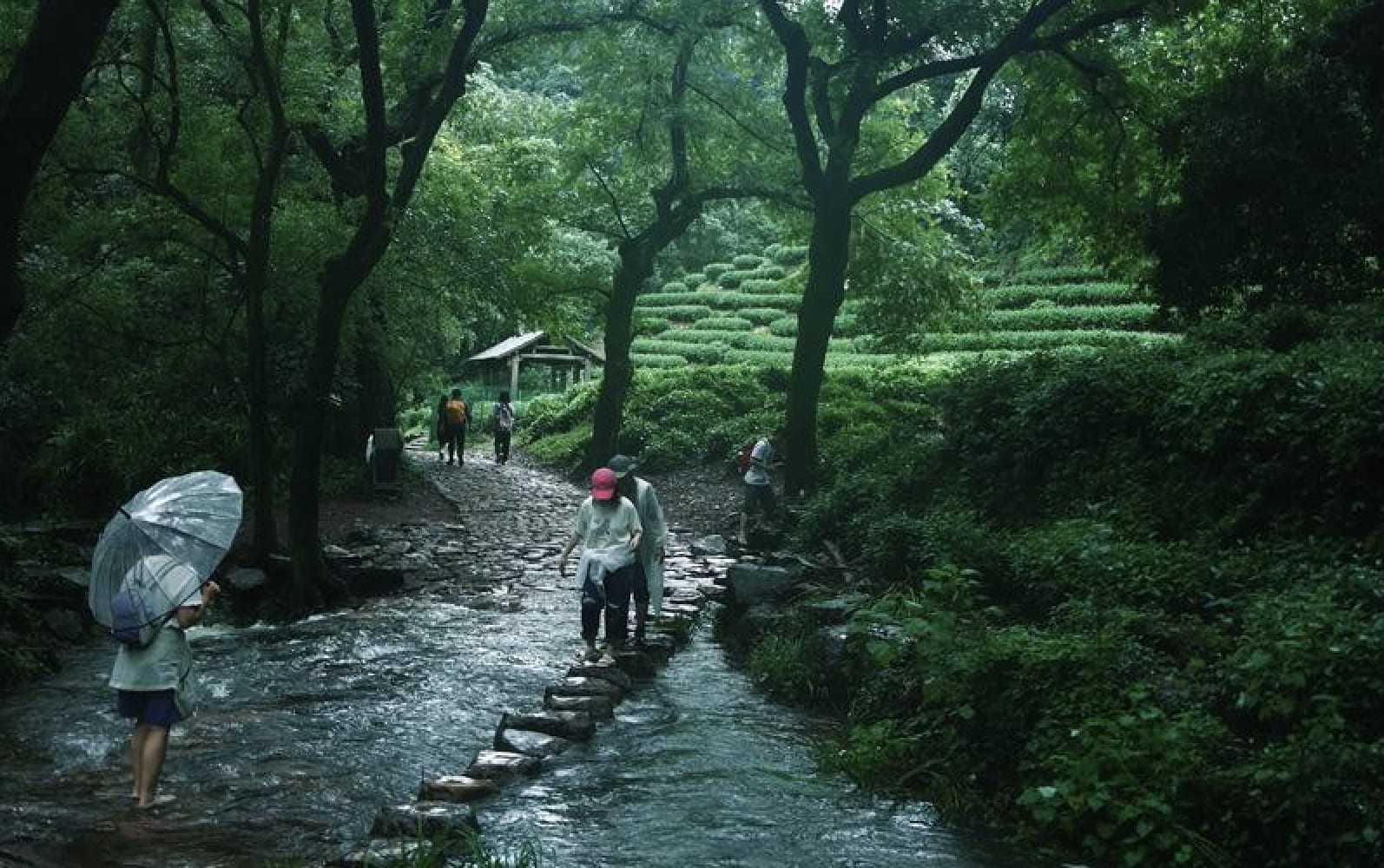
During spring harvest (March–May), the Longjing tea terraces are active worksites. Tea pickers, almost always women in wide-brimmed hats with baskets on their backs, work the terraces from early morning until mid-afternoon.
Stay on the main path and do not walk through the rows where people are actively picking. If you need to pass someone working on a narrow terrace path, wait for a gap or say 你好 (nǐ hǎo), they will usually step aside.
Photographing tea pickers: always ask first. A smile and pointing to your camera is enough. Many pickers will wave you off if they do not want to be photographed, or nod if they are fine with it.
Some farmers may invite you to try their tea. This is a genuine gesture of hospitality. Accept if you have time, it is one of the best experiences in the tea hills. A small purchase (¥50–100 for a bag of tea) is appreciated but not required.
Smoking
Smoking is common in public spaces in China, including on hiking trails. You will encounter people smoking while walking on all routes. This is legal and normal.
If smoke bothers you, step upwind or increase your pace to pass. Most smokers are considerate about not smoking directly in someone's face, but they will not move away from the trail to smoke.
Cigarette butts on the trail are unfortunately common. Do not follow this example, pack out everything you bring.
Note: smoking is prohibited inside temple grounds (Lingyin Temple) and some scenic area buildings.
Noise
Chinese hiking culture is social and often loud. Groups hike together, talk at conversational volume, and sometimes play music from portable speakers. Quiet contemplation on the trail is not the default mode in China, hiking is a social activity done with friends.
If you want a quiet hike, go early (before 8am) on a weekday. Weekend mornings are quieter than afternoons. The trails are never completely silent, but early weekday mornings come closest.
Headphones or earbuds are fine. Many locals wear them too.
Litter
Littering is more common on Chinese trails than on trails in many Western countries. You will see plastic bottles, snack wrappers, and orange peels at rest points and scenic viewpoints. This is not an endorsement to do the same.
Pack out everything you bring, including organic waste. Orange peels and banana skins take months to decompose and attract insects. The trail has no trash bins in most sections.
If you want to make a positive impact, carry a small bag and pick up a few pieces of litter. Local hikers who see this may nod in appreciation. It is a small gesture that builds goodwill.
Photography of Locals
Landscape and trail photos are fine everywhere. Photographing people requires more care.
Do not photograph: elderly people without asking (many are superstitious about cameras), monks without permission, tea pickers up close without a nod first, or anyone who waves their hand to say no.
It is fine to photograph: your hiking companions, the scenery, trail signs, temples from the outside (check for photo-prohibition signs), and people who have clearly posed or agreed.
A good rule: if you would not want a stranger taking your photo while you work, extend the same courtesy to tea pickers and farmers.
Right of Way
There is no formal right-of-way convention on Chinese trails. On narrow paths, the general practice is: step aside for faster hikers coming from behind, and step aside for people coming uphill if the path is narrow. A simple 谢谢 (xiè xie) as you pass is polite.
When passing on stone steps, the person going uphill generally has the harder task, if you are descending, step aside briefly to let them pass without breaking their rhythm.
On wider flagstone paths, people pass on whichever side is convenient. Do not expect a dedicated walking lane.
Group vs. Solo Hiking
Most hikers in Hangzhou are in groups of 2–8 people. Solo hiking is less common but perfectly acceptable. You will be the only solo hiker on most trails, but no one will find this strange or concerning.
Do not be surprised if a group invites you to join them for tea or offers to take your photo. Hospitality on the trail is genuine and common. If you want to accept, a 谢谢 (xiè xie) and a smile is all that is needed. If you prefer to hike alone, a polite "谢谢, 我自己走" (thank you, I will walk on my own) works.