Granite Flagstones
This is the most common surface on established Hangzhou hiking routes. Wide, smooth granite slabs laid as a continuous path. They look clean and well-maintained, which they are, but they become extremely slippery when wet. On the Lingyin to North Peak trail, most of the ascent is granite flagstone. In dry conditions they offer excellent grip. After rain, even gentle slopes become treacherous. This is the surface that causes the most slips and falls.
Found on: Lingyin to North Peak (most of the trail), sections of Nine Creeks approach.
Concrete Steps
Many hill climbs in Hangzhou are not dirt trails but concrete staircases. These are steep, even, and uniform, like climbing an outdoor staircase in a park. They are hard on knees when descending and can feel monotonous, but they are stable in all weather. Baoshi Mountain's approach from Beishan Road is concrete steps with stone facing. Some sections of the Lingyin ascent also use concrete stairs.
Best approach: take your time on the descent, use your knees with care, and consider trekking poles if your knees are sensitive.
Found on: Baoshi Mountain approach, sections of Lingyin ascent.
Packed Earth & Tea Terraces
The paths through Longjing's tea fields are mostly packed earth, hard, compacted dirt that forms stable walking surfaces. These are pleasant to walk on and provide good grip in dry weather. After rain, they become muddy and sticky. Many tea-terrace paths have narrow drainage channels crossing them every 10–20 meters, step over these carefully as they can be 20–30 cm deep.
The paths are narrow, often just wide enough for one person. During spring harvest season, these paths may be occupied by tea pickers working the terraces. Step aside and let them pass.
Found on: Longjing to Nine Creeks (first half), Meijiawu area.
Stream Bed Stones
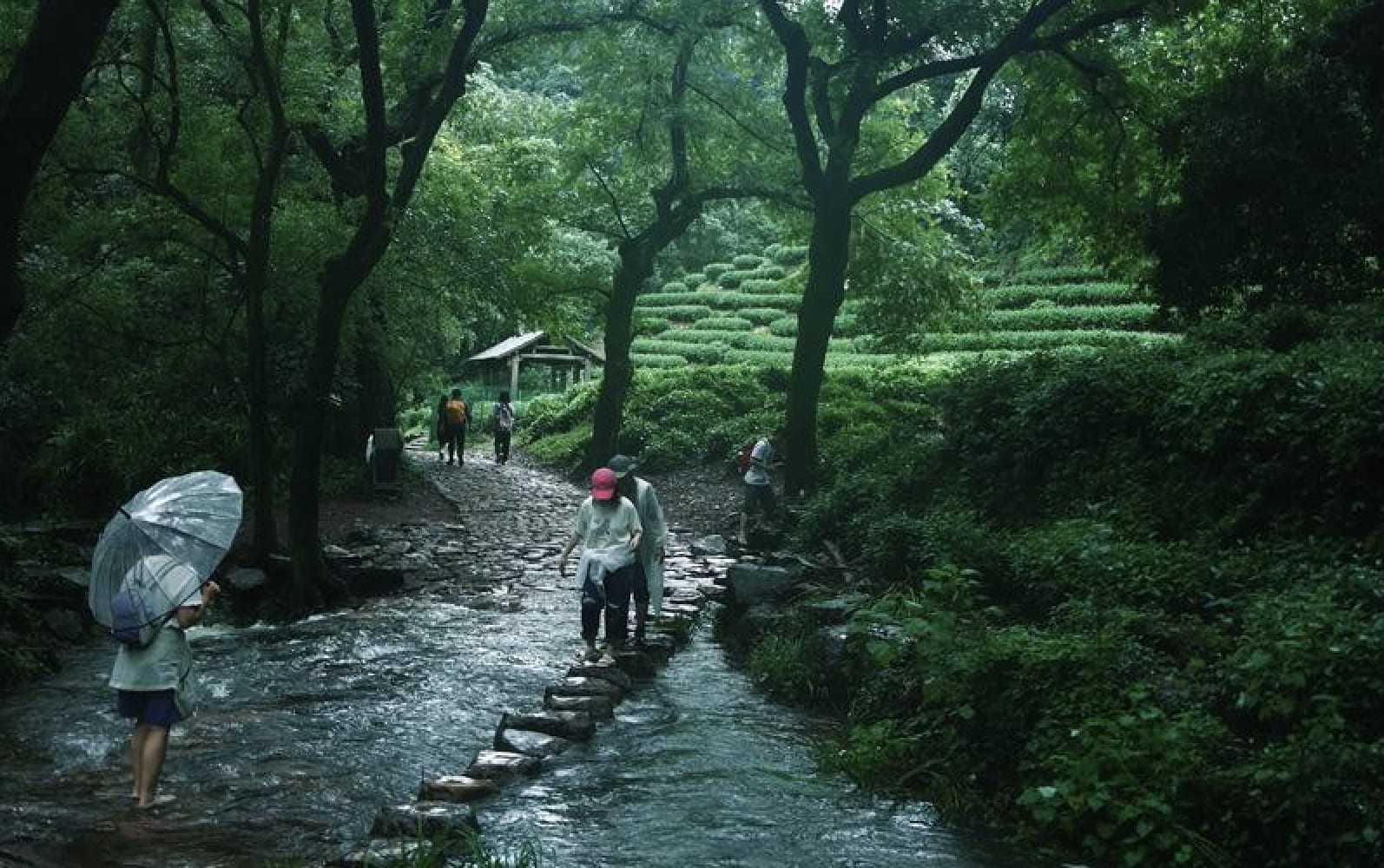
The Nine Creeks section of the Longjing route includes stretches where the path runs alongside or crosses the stream. These sections are uneven, loose stones of varying sizes, like walking on a dry river bed. Waterproof footwear is advised because you may need to step through shallow water at several points. The stones shift underfoot, so take your time and watch your footing.
Found on: Nine Creeks (九溪) section of Longjing route.
Road Connectors
Short sections of paved road connect trail segments in several routes. These are usually quiet residential or park roads, but some are shared with scooters, bicycles, and the occasional car. The road section between the Nine Creeks exit and the bus stop is about 300 meters of paved road. The approach to Longjing Village from the bus stop is also paved.
Stay to the side, face oncoming traffic where there is no sidewalk, and be aware of electric scooters, they are silent at low speed.
What Shoes to Wear
Trail running shoes with good grip (Vibram or similar) are the best choice for all routes on this site. The combination of wet-stone grip and packed-earth traction covers 90% of the surfaces you will encounter.
Hiking boots are overkill for most Hangzhou trails. The trails are not long enough or rugged enough to justify ankle support, and boots tend to be heavier and hotter in Hangzhou's humid climate.
Avoid smooth-soled sneakers, fashion trainers, or shoes with worn-down tread. They are genuinely dangerous on wet granite flagstones, the most common trail surface.
For rainy season (March–April, June), bring waterproof trail runners or light walking shoes with good tread. Your feet will get wet from puddles and stream crossings regardless, so quick-drying shoes are more practical than waterproof boots.